Search

Your search for: "" revealed the following:

Search...
nSide™
  • Home
    • Log In
  • Why nSide?
    • Success Stories
      • Colbert County Schools
    • Channel Partners Program
    • Careers
  • Safety Solutions
    • nSide School Safety Platform™
    • nSide|Assess™
    • nSide|Boost™
    • nSide|Edge™
    • nSide|Fleet™
    • nSide|Live™
    • nSide|Lockdown™
    • nSide|Training™
    • nSide|Views™
    • Site Security Assessment
  • Marketplace
  • Resources
    • Alyssa’s Law
    • Blog
    • Community Articles
    • Educator Resources
    • Free Resources
      • CPTED For Schools
      • Dynamic Mapping Guide
      • Safer Schools Checklist
      • Safety Through Collaboration
    • Mapping Process
    • nSide Press
    • Training Archives
  • Funding
nSide™
nSide|AcademySubmit A TipLog InSearch
  • Home
    • Log In
  • Why nSide?
    • Success Stories
      • Colbert County Schools
    • Channel Partners Program
    • Careers
  • Safety Solutions
    • nSide School Safety Platform™
    • nSide|Assess™
    • nSide|Boost™
    • nSide|Edge™
    • nSide|Fleet™
    • nSide|Live™
    • nSide|Lockdown™
    • nSide|Training™
    • nSide|Views™
    • Site Security Assessment
  • Marketplace
  • Resources
    • Alyssa’s Law
    • Blog
    • Community Articles
    • Educator Resources
    • Free Resources
      • CPTED For Schools
      • Dynamic Mapping Guide
      • Safer Schools Checklist
      • Safety Through Collaboration
    • Mapping Process
    • nSide Press
    • Training Archives
  • Funding
VIEW OUR BROCHURE
REQUEST A FREE DEMO
  • Home
    • Log In
  • Why nSide?
    • Success Stories
      • Colbert County Schools
    • Channel Partners Program
    • Careers
  • Safety Solutions
    • nSide School Safety Platform™
    • nSide|Assess™
    • nSide|Boost™
    • nSide|Edge™
    • nSide|Fleet™
    • nSide|Live™
    • nSide|Lockdown™
    • nSide|Training™
    • nSide|Views™
    • Site Security Assessment
  • Marketplace
  • Resources
    • Alyssa’s Law
    • Blog
    • Community Articles
    • Educator Resources
    • Free Resources
      • CPTED For Schools
      • Dynamic Mapping Guide
      • Safer Schools Checklist
      • Safety Through Collaboration
    • Mapping Process
    • nSide Press
    • Training Archives
  • Funding
  • nSide|Academy
  • SUBMIT A TIP
REQUEST A DEMO
nSide™
nSide™
  • Home
    • Log In
  • Why nSide?
    • Success Stories
      • Colbert County Schools
    • Channel Partners Program
    • Careers
  • Safety Solutions
    • nSide School Safety Platform™
    • nSide|Assess™
    • nSide|Boost™
    • nSide|Edge™
    • nSide|Fleet™
    • nSide|Live™
    • nSide|Lockdown™
    • nSide|Training™
    • nSide|Views™
    • Site Security Assessment
  • Marketplace
  • Resources
    • Alyssa’s Law
    • Blog
    • Community Articles
    • Educator Resources
    • Free Resources
      • CPTED For Schools
      • Dynamic Mapping Guide
      • Safer Schools Checklist
      • Safety Through Collaboration
    • Mapping Process
    • nSide Press
    • Training Archives
  • Funding

Your search for: "" revealed the following:

Search...

Posted by admin

HomeArticles Posted by adminPage 9

Grant Funding Webinar

Time is running out to claim funds for your school!

Deadlines are quickly approaching on several grants and we don’t want you to miss out! We are hosting two webinars to walk you through the application process for three available funding opportunities:

FCC Emergency Connectivity Fund: Deadline August 13th

Advancement and Technology Fund (A&T Fund): Deadline August 17th

American Rescue Plan Elementary and Secondary School Emergency Relief Fund (ARP ESSER)

Let us show you how to get access to the money that has been allocated for your school and how to put those funds to good use by keeping educators and students safe. Don’t miss out on your chance to do everything you can to make your school safe – at no cost to you! 

We have two options for you to participate: 

August 6th at 10:30AM
August 10th at 2:30PM

Click the links to register to attend – at the end of each webinar, we will send out a copy of the applications, all the links needed to complete the grant applications, and a quick reference sheet to use when applying. 

We can’t wait to see you there! 

admin
August 4, 2021
0
Share:

How Alabama Schools Can Prepare for their EOP Monitoring

Alabama Schools Must Have Updated Emergency Operations Plans

Emergency planning is essential to the safety of students and staff in Alabama schools. Each year, starting July 1st, Alabama schools are required to re-enter their emergency operations plans into the nSide platform. School districts in Alabama are required to make sure their Emergency Operations Plan is updated and fully compliant with the state mandate.

New Emergency Operations Plans are Required July 1st

On July 1st each year, the existing EOPs for the previous school year become void and need to be re-entered into the nSide platform. This means that each school will be responsible for making sure the information in the EOP is up to date and everyone in the school community knows exactly how to execute these plans in the event of an emergency. Taking the time to make sure your EOPs are ready to go can save valuable moments that can very literally mean the difference between life and death when the unthinkable happens.

What should all Alabama School Emergency Operations Plans Contain?

Each Alabama Emergency Operations Plan contains a myriad of directives that need to be completed to not only satisfy a government requirement, but also make your school safer. As per Alabama rules, each EOP needs to contain the following items:

  • Introduction & Statement of Commitment
    • Statement of Commitment
  • EOP Core Planning Team   
    • School EOP Core Planning Team
    • School Comprehensive Emergency Telephone Listing
  • NIMS & ICS  
    • Staff Skills Survey & Inventory
    • Incident Command System Roles
  • List of Materials 
    • List of Materials and Equipment
    • Basic Resources Needed
  • Hazard-Specific Annexes 
    • Identification of Hazards (School Grounds)
    • Identification of Hazards (Classroom)
    • Identification of Hazards (Along Evacuation Routes)
    • Identification of Hazards (Neighborhood and Communities)
    • Analysis of Identified Hazards
  • Functional Annexes   
    • General Emergency Procedures
  • Drill & Training Reports

nSide Makes Alabama EOPs Easy

All public schools in Alabama are registered nSide users. If you are an nSide user,  you can easily check to see if your school’s EOP is compliant or not, or check in with our live chat and our team can run a report that analyzes your EOP in comparison with Alabama requirements. Our platform is set up to check your compliance automatically and let you know areas that need improvement. We can also help you digitally collect all information from everyone involved in the safety process, making the process of updating your EOPs quick and easy. If you’re unsure of how to better format your EOPs, or if you’re one of the schools that is due for compliance monitoring in the 2021-2022 school year, we can help you get everything prepared.

Watch this video to see how to properly update your Alabama School EOP

We can help make your school’s EOP easier and more effective! Call us today to find out how!

1.800.604.1822

admin
July 14, 2021
0
Share:

Alabama Schools Can Now Upgrade Technology Funding at No Cost to You!

What is A&T Funding?

Alabama Governor Kay Ivey announced earlier this year that the state of Alabama  is giving away funds for schools to improve their school’s safety. According to the State memorandum, the money can be used for repairs and deferred maintenance, classroom instruction support, insuring facilities, transportation, school security, and education technology and equipment. Each K12 school district in the state has been allocated a portion of  the total $206million dollars package to purchase these upgrades. Alabama higher education, including community colleges,  have been awarded $76 million. 

CLICK THIS LINK TO SEE HOW MUCH EACH DISTRICT HAS BEEN AWARDED. 

Why are technology upgrades important in Alabama schools?

This funding comes at a critical time in the state, as many schools are still working through gaps in technology and access revealed by the COVID-19 crisis. At a time when many students are tracking behind grade level,  this key injection of funding can help Alabama school students feel safer and enable learning to flourish in the new school year.  One of the key uses for these funds as outlined by Governor Ivey is for “School security measures as a component of a systemwide security plan”. Because the nSide platform is registered to all public schools in the state of Alabama, all public schools in Alabama can now upgrade their nSide base platform to include camera systems, door lock system, fleet management, and many other technology add-ons, and will qualify for the funding. 

What can you do with the 2021 Alabama A&T Funding money?

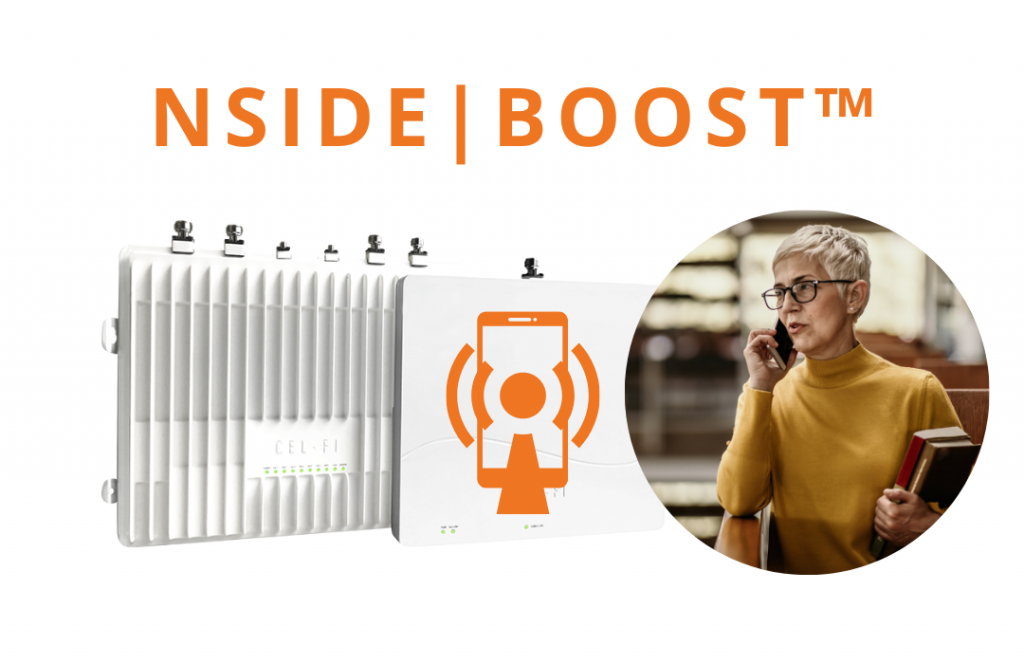
All Alabama schools already have the base platform. The following technology upgrades are eligible at NO COST TO YOU because the funding will be coming from the Alabama A&T fund:

Call to Request a Quote Now

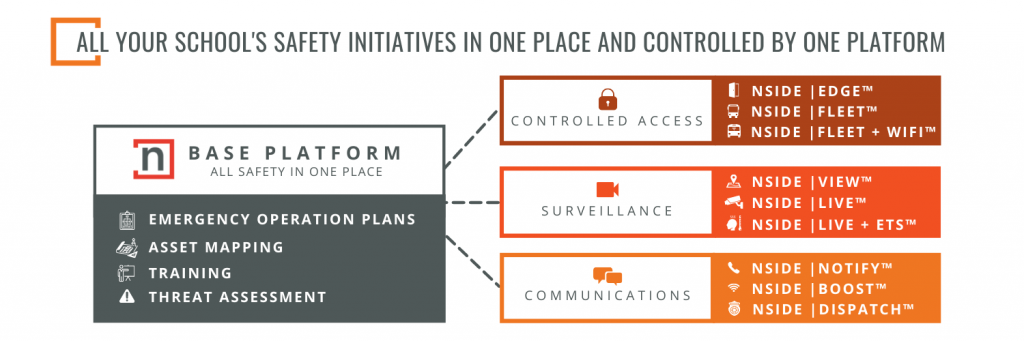
Each technology upgrade we offer seamlessly integrates with the nSide platform so you can manage all your school’s safety technology in one place. This means that all members of your school’s safety team, including administrators, SROs, law enforcement, EMS, and more can know ahead of time what to do in an emergency, and exactly how to react to save lives. 

The Deadline to Apply is August 17, 2021.

As with all state funding, these funds are available to claim until the August 17 deadline, and will then no longer be available. It’s a “use it or lose it” offer. If your school is in need of safety and technology upgrades, we can help you apply. 

Call or Email us today to get started! 1800.604.1822 or help@nside.io

admin
June 22, 2021
0
Share:

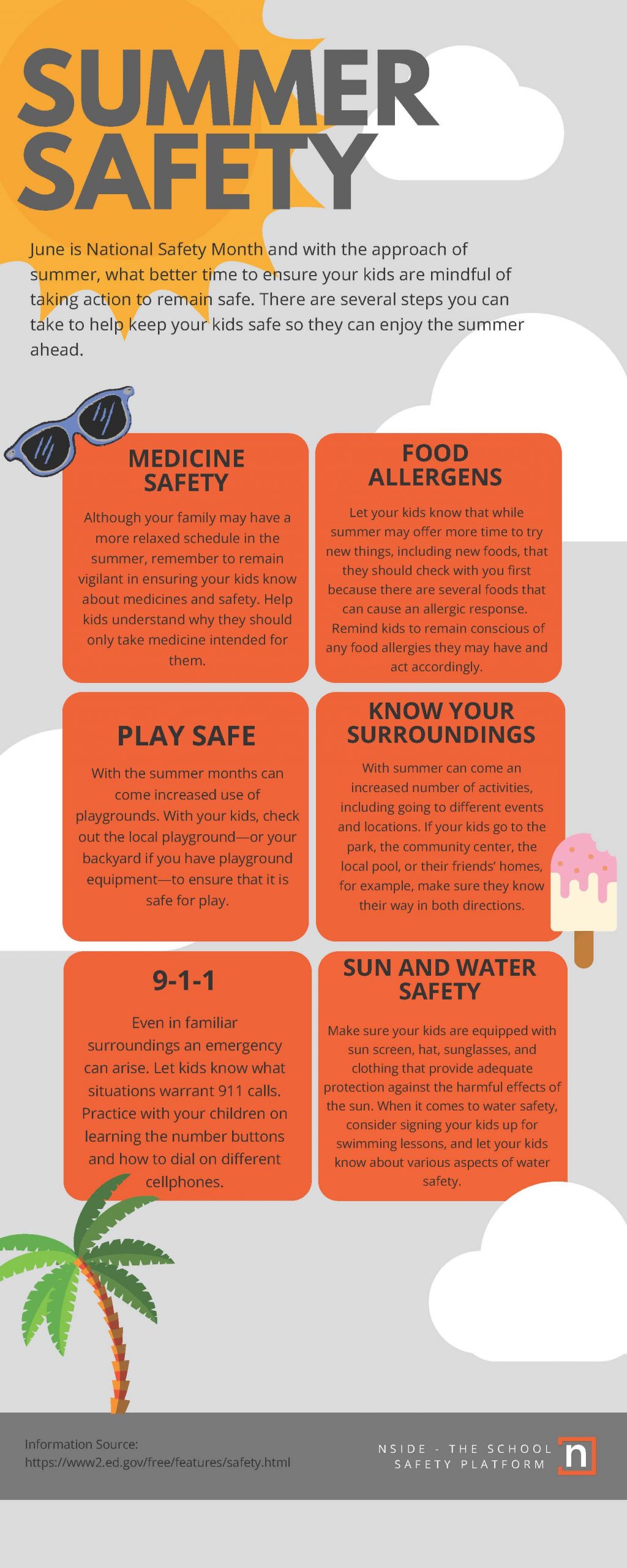
Infographic: Stay Safe Over the Summer

summer safety infographic- nside the school safety platform
admin
May 22, 2021
0
Share:

Six Things your Alabama School can do with their CARES Act funding

The recent passage of the CARES (Coronavirus Aid, Relief, and Economic Security) Act is something that brought many American households hope and tangible financial assistance. However, as with many similar bills, the verbiage can feel complex, and many people may not realize that the act offers additional help in other sectors. When it comes to school safety, we always get excited over anything that helps schools update or improve their security, but we REALLY love the benefits of the CARES act: over $899 million dollars in funding for technology upgrades! What does this mean for you and your school? Only the best news ever! You can now receive nSide products AT NO COST because of this funding and its implications. 

In accordance with the guidelines laid out by the CARES Act, our products and services meet the criteria, such as developing procedures to improve response efforts of local agencies, facility upgrades, repairs or improvements that can support student’s health needs, and purchasing educational technology. To get started, claim your funding HERE, then read on to find six things you can do with this important money:

Start planning ahead with the nSide Base Platform.

  1. This is our signature product, and it works in tandem with all our other products to enhance your emergency planning and communication. It includes components like mapping and 360 degree views of your campus, creating and storing your emergency plans, help with compliance for state and local guidelines, and training for your school community (staff, students, and educators) in protocols and procedures. 
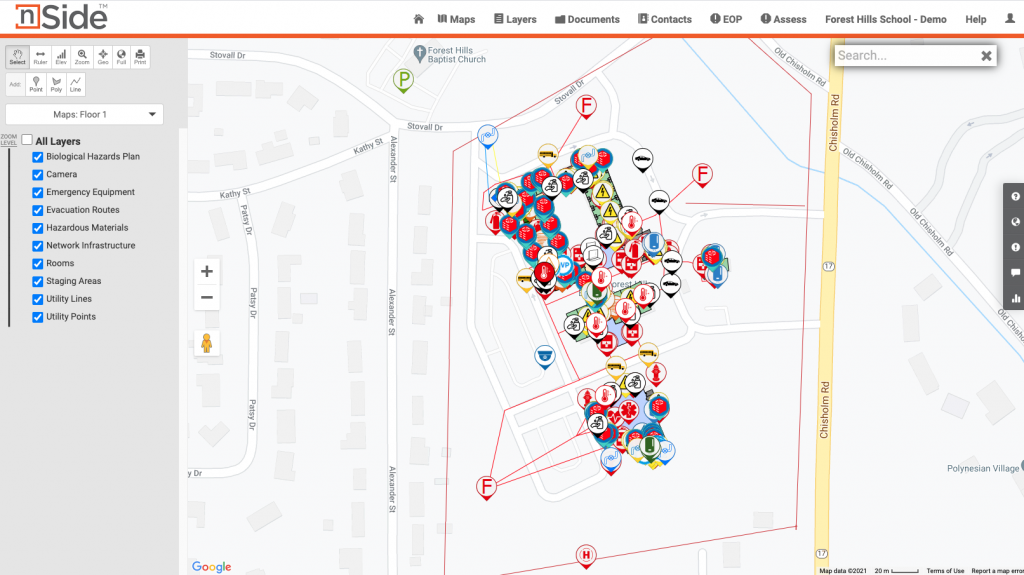
nSide Base Platform

Be more prepared with nSide|View.

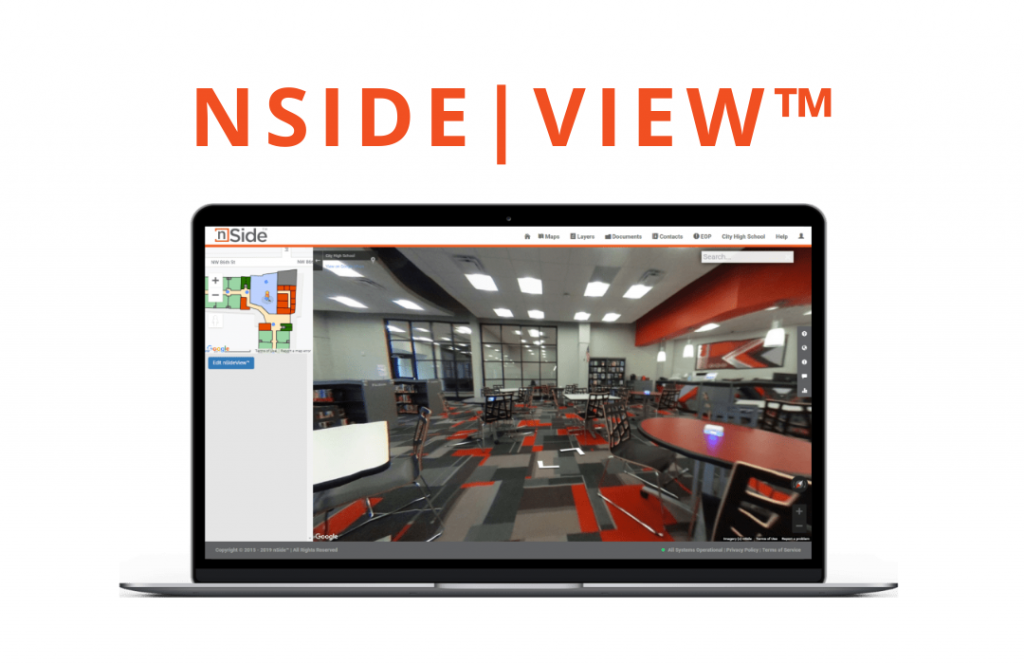
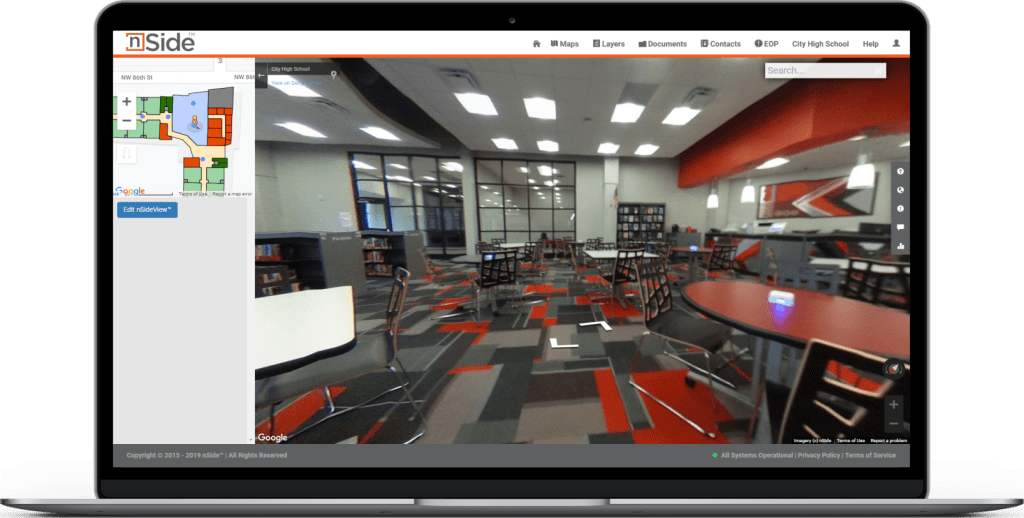
nSide|View is like a digital blueprint of your school. It links images and photographs together to create a virtual walk-through of the structures, and provides first responders with accurate and detailed exits, entrances, and anything else they’d need to know. It also helps you base emergency decisions on more than old paper maps of your school’s rooms, hallways, and more. 

nSide | VIEW

Gain extra insight with nSide|Live.

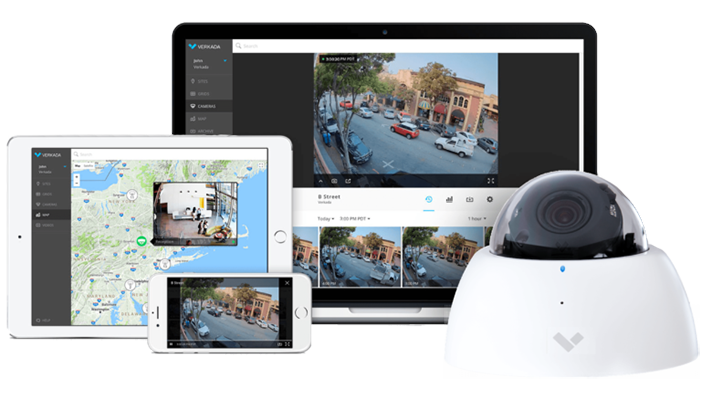
Ever wished that you had an extra set of eyes (or two)? That’s what you will gain when you use the nSide|Live platform: extra viewing abilities to help in an emergency, to help protect students from bullying, drugs, and crime, and a secure way to view happenings on campus. Best of all, this data can be provided to first responders in an instant, giving them potentially life-saving information rapidly and in real-time. 

nSide | Live

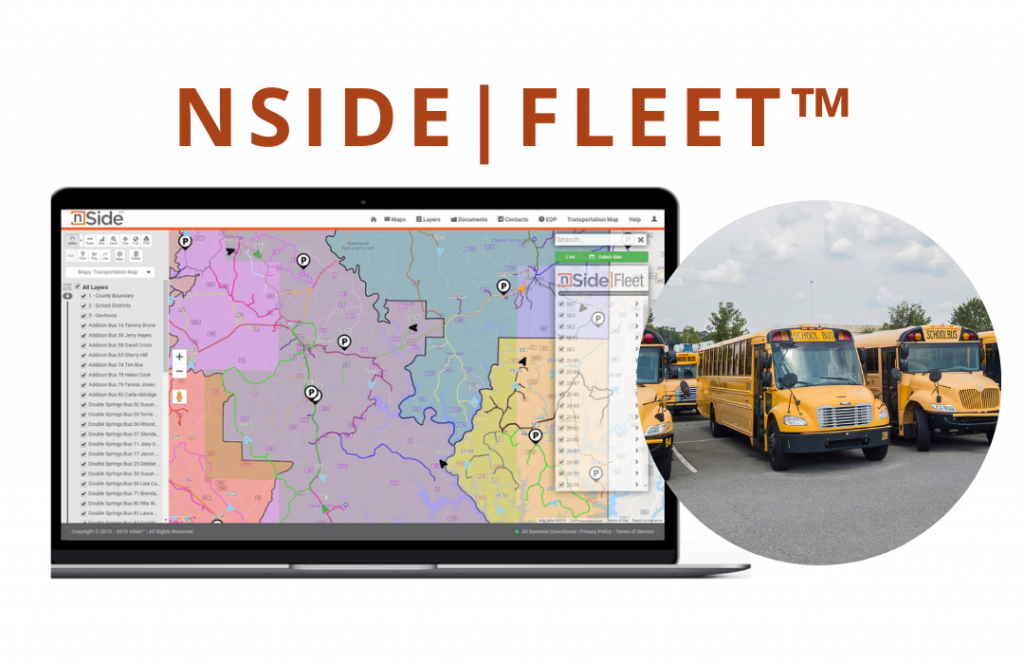
Monitor your school bus systems with nSide|Fleet.

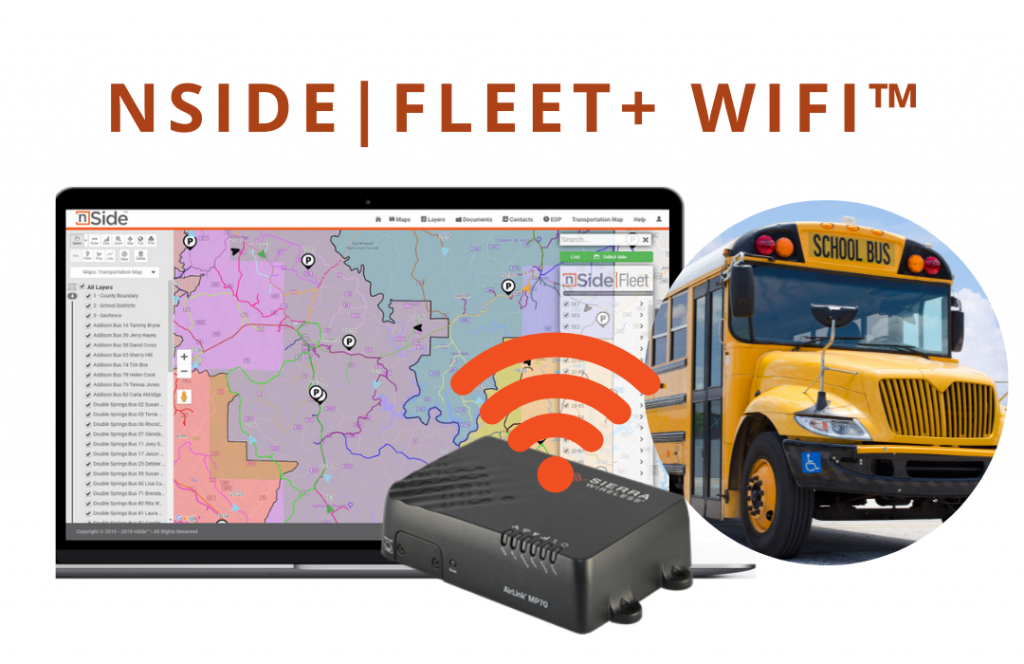
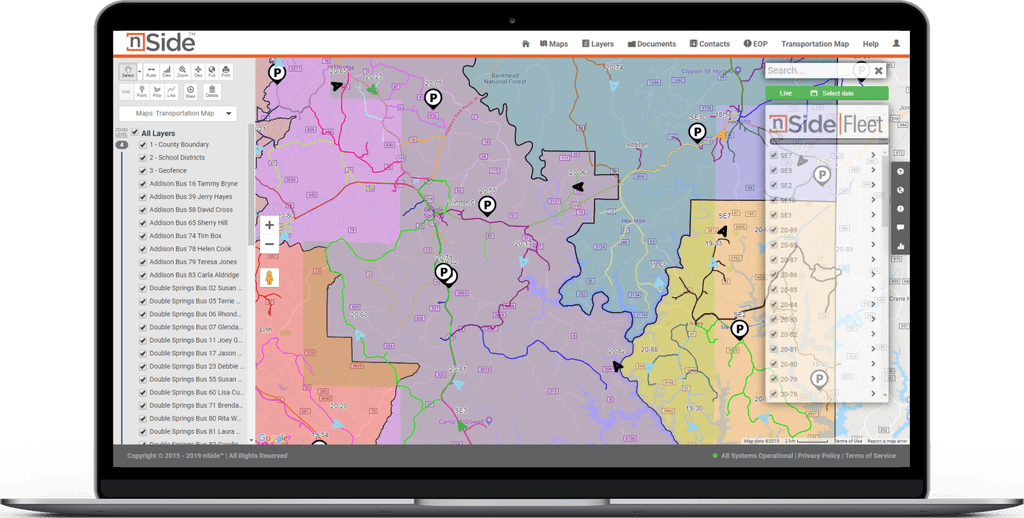
This comprehensive way to keep track of your students and drivers keeps them safe and allows emergency personnel to reach them in the event of a crisis. You can also view reports that show fuel levels, maintenance issues, and geofencing to ensure the utmost safety for the children under your care. 

nSide | Fleet

Close off your campus with one-touch with nSide|Edge.

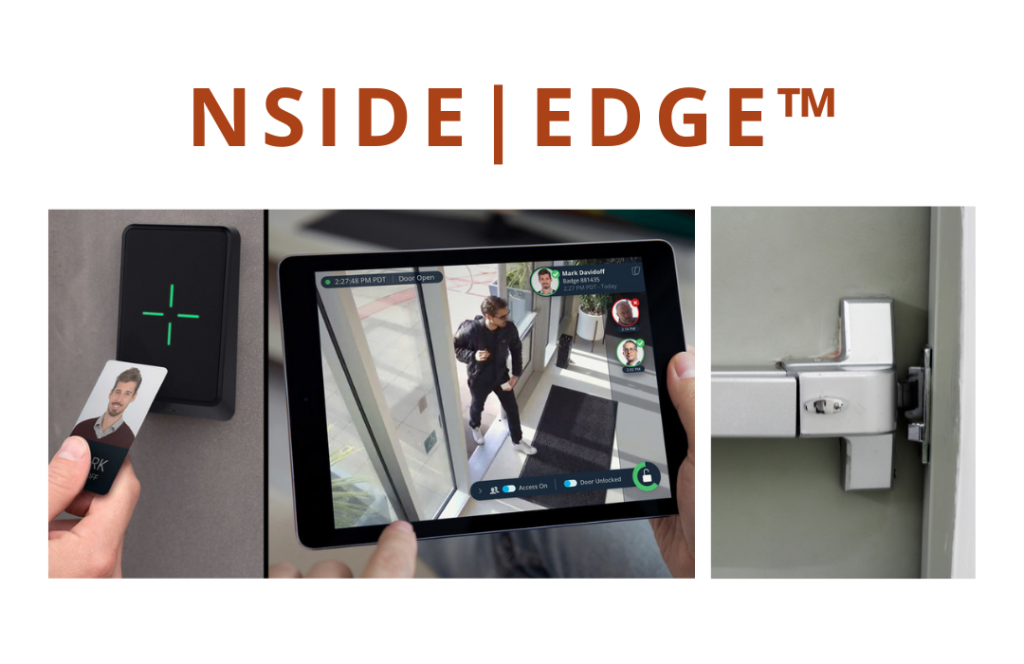
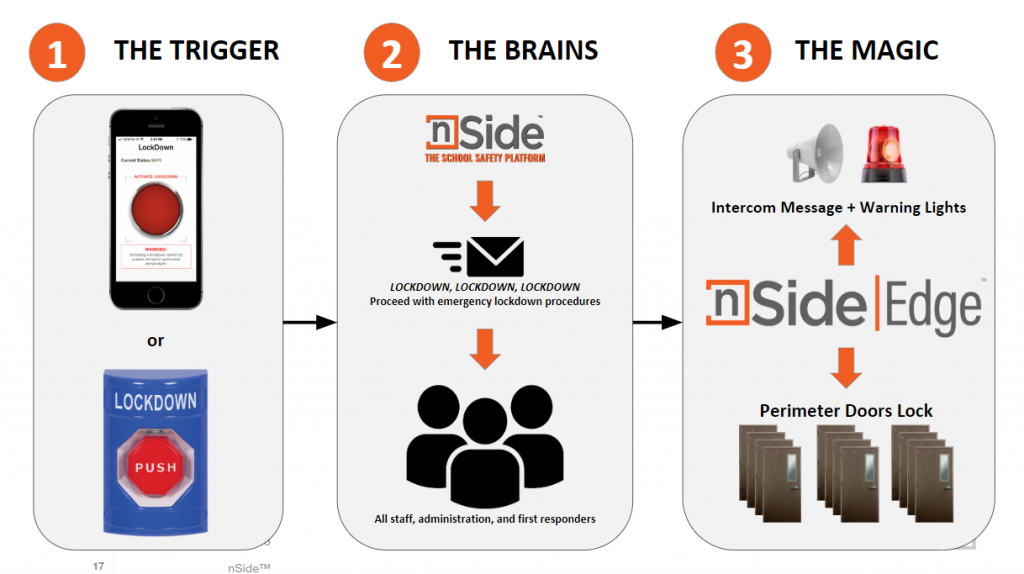
This amazing piece of technology gives the ability to lock down the campus doors with just one click. This is effective in the event of active shootings, or any instance where an immediate lockdown would be needed. You can also schedule when doors are locked to coordinate traffic flow through your building. Be assured that the ability is completely secure, so only authorized personnel would be able to initiate the lockdown procedures! 

nSide | EDGE

Reach the most critical audience with nSide|Notify.

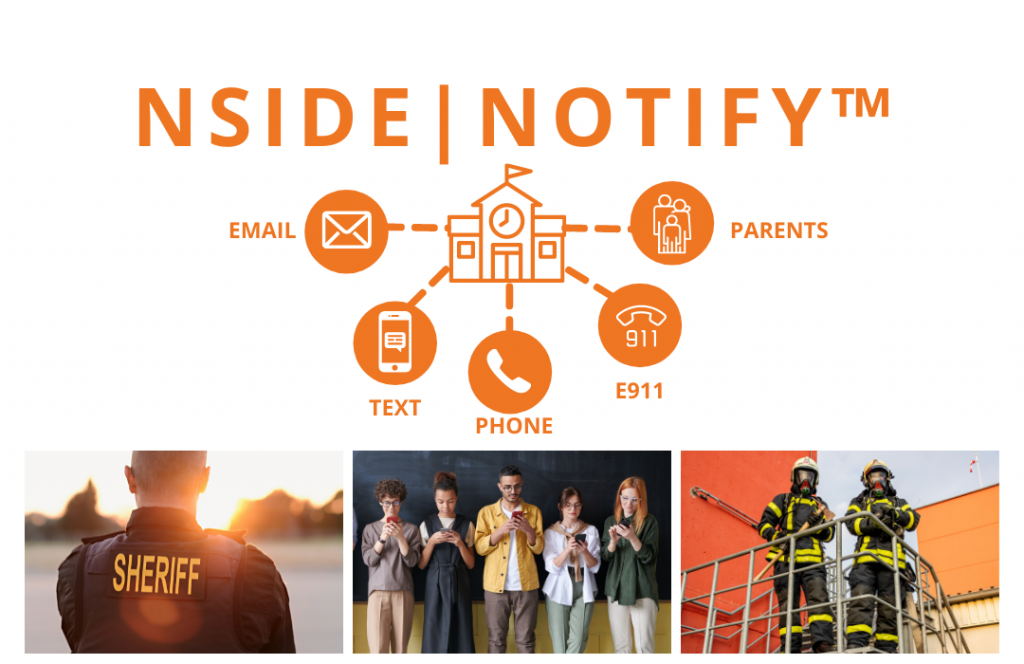
When you need to reach parents, students, or staff in a hurry, you will want a quick, cohesive way to do so in a professional way, and nSide|Notify is the answer. It uses the existing communication standards at the school, and integrates them to decrease lag time in an emergency and allow mass communication in a smooth manner. It saves you time when moments matter!

This funding can make a huge impact on your school, and the process to receive it is simple and straightforward. If you’re unsure if you can integrate or install our products or services, we would love to connect you with our team members. They can walk you through the steps to decide which products meet the guidelines for your specific campus, and how to get started! 

admin
May 6, 2021
0
Share:

School Safety in Bad Weather

The age old saying that, “April showers bring May flowers” is true. It evokes visions of beautiful tulips and bright yellow rainbows, with blue skies and sunshine just around the bend. However, there is another aspect of springtime that is less obvious…and more deadly: bad weather that can threaten school buildings and the children inside of them. School safety is what we specialize in, and weather is another aspect that can be overlooked, yet is just as important to protect from. Depending on the part of the country you live in, the difficulties of bad weather can include things like flooding, tornadoes, hurricanes, and ice storms. These can happen throughout the year, but springtime is the perfect opportunity to reassess the safety measures in your school, and prepare for whatever may come your way via Mother Nature. Here are our best tips to building a safe and secure plan for severe weather: 

Educate yourself about the weather and communications

Do you know the difference between a “watch” and a “warning”? Knowing the terms that meteorologists use when they communicate risk and threats can help you know when it’s time to alert your school or staff, and when you have time to wait. How do you become more educated? We like this little guide from ABC News that outlines some basic weather lingo, including information on how tornadoes are staged and measured, and what the difference is between a funnel cloud and a tornado (pro tip: they’re actually not the same thing!). Accuweather is one of the best websites and apps for quick news and updates. Bonus: it shows hourly rain levels! Hazardous Weather Outlooks are notices issued from the National Weather Service, so knowing how to access these will also be helpful (find those HERE). 

Decide on a cohesive chain of command

If you are an administrator, you need to be sure your team is on board with the who, what, when, and where for disseminating all of the crucial information when the time comes. Time is of the essence when it comes to severe weather, and you will not have time to waste figuring out things like: Who is sending texts or alerts to parents, and what level of severity will trigger those? How long before an event like a tornado or super storm will you decide to close or shorten a school day? How will you alert those on the campus, and who will be in charge of executing that job? Not only do you need to make these decisions ahead of time, but be sure to communicate frequently and thoroughly so that everyone knows their role, and when they’ll need to step into it. If members of your response team are also teachers, don’t forget to make a secondary plan for where their classes will go if they need to step into an emergency role during the school day. Don’t forget to also designate two people who know how to turn off the electricity and gas if the school sustains damage (in fact, assigning tasks to two people is always wise, in case one cannot get to the building or isn’t on campus). 

Don’t forget the school busses

Transportation happens all through a school day, depending on how your bus routes run and their timing. Because storms or tornadoes can happen rapidly and events unfold quickly sometimes, your bus routes need to be considered in your plan of action as well. Coordinate with your drivers about what they should do if a tornado watch is issued, and come up with a few shelter options (such as caves, structures) along the daily routes. You can find out more about nSide’s fleet systems HERE, which offer schools an extra layer of protection and communication. 

Examine your structure or plan for new structures

Whether you are building a new school or are in a decades-old structure, knowing the blueprints, exit routes, and stability of the buildings is one of the most crucial steps during a weather warning or evacuation. Roger Edwards from the Storm Protection Center explains that this is important because it can save lives. He recommends consulting professional architectural engineers to find the “weak spots” in your building, and know where NOT to send students for shelter. He also explains that if you are building a brand-new structure, referencing guides such as the FEMA tornado shelter guide is a helpful primary step. If you don’t have the budget or ability to build brand new classrooms, you can hire someone to line some of the interior rooms with concrete. He cautions that this can be costly if you are adding them onto an existing building, so you will want to estimate costs for new and retrofitted choices. Lastly, Edwards emphasizes that children should never be sheltered in place in portable classrooms, which are dangerous, and should also not be ushered into large rooms such as gyms or auditoriums. These rooms have structural weaknesses that can cause them to collapse with even low-level wind speeds. 

Plan for power failure

Many emergency plans hinge on the idea that you will have access to electricity. With most school buildings having generators meant to turn on when the power fails, it can be something you take for granted, but losing power can become a reality very quickly. Experts from the Weather Service recommend that you not only make a structured plan, but have a backup plan that can be executed without power. For example, if your school uses a tone or alarm system to warn students or staff, after losing power, you will not be able to reach a large number of people using that strategy. Keep a compressed air horn or portable megaphone on campus, which can be used to alert the people around you to an emergency. 

Let parents know what to expect

One of the things that sends parents into chaos very quickly is a lack of communication. If your child is in danger, or you perceive that they may become threatened, you want answers and to know who is in charge. Issuing instructions before the school year begins will give parents a clear expectation of who will be contacting them, how (such as text messages, emails, etc.), and under what circumstances their child may be kept late at school. Research shows that children are safer within the walls of secure and reinforced school rooms, rather than on a bus or in a car, so many schools opt to keep children longer during severe weather. A simple PDF, sent to all parents or guardians, can be easily accessed and stored on the school website if parents need to find it, so they can understand the process of notification. If you are able, designate a specific phone number or email and someone who can man it, so parents can reach someone to find out information. When things are resolved or the storm has passed, don’t neglect to send out an “all clear” or message of finality to parents so they are aware the danger is no longer present. 

After the storm has passed, your job isn’t over! 

Assessment after the danger is no longer a problem is one of the best things you can do to prevent problems in the future. The National Weather Service recommends that you have staff check all the buildings for damage before you release students to go home or leave the campus, and that you have a system in place to let them know when it’s safe to exit. They also recommend periodic practicing of plans such as tornado drills so it doesn’t alarm children when it’s the real deal (with younger children, this can be traumatic, so you want to be clear about what is a practice and what isn’t. It’s also beneficial to alert parents when you will be doing drills, so they can discuss with their children about any fears they may have). Finally, sit down with your disaster team or staff and go over what can be improved, and what worked well. Stay positive and open-minded during these reviews so everyone feels that their opinions can be heard and implemented when appropriate. Make notes about things that didn’t work, so they don’t get repeated. 

Keeping students safe in severe weather can feel intimidating and like a ton of pressure. It is always a big responsibility to be in charge of other people’s children, but preparation is the key component to running a smooth plan of action in a crisis. Since we specialize in safety here at nSide, we understand the demands on school administrators who are in charge of campuses, and that’s why we want to come alongside you. Together, we can strengthen your safety plan and build your confidence so that when the time comes, you will know exactly what to do! Visit our website today HERE to find out how you can be matched with one of our professionals and assess your school’s safety plan! 

Sources: 

https://www.spc.noaa.gov/faq/tornado/school.html

https://www.weather.gov/grb/schools

https://abcnews.go.com/US/weather-terms-season-abc-news-meteorologists/story?id=54361705

https://www.accuweather.com

https://www.fema.gov/sites/default/files/2020-07/safe-rooms-tornadoes-hurricanes.pdf

admin
April 23, 2021
0
Share:

How Camera Systems Can Improve School Safety

How safe is my child’s school?

This is an unsettling question that many parents have found themselves asking more frequently over the last twenty years. It’s not a comfortable topic, but after the shootings at Columbine High School in 1999, school safety was thrust into the spotlight. Today, gun violence, bullying, and other related issues are paramount in the public school sector, and can leave parents and educators wondering how school safety can be improved or enhanced. It’s one of the things that we here at nSide have set out to do: build confidence in the school systems, so they are well-equipped to handle anything that comes their way. 

Are schools truly unsafe?

There are many issues facing school administrations today. Depending on the region in which a K-12 school is located, some of these include: 

  • Bullying and Cyberbullying
  • Gun violence
  • Student and Teacher Mental Health
  • Natural Disasters (such as hurricanes or tornadoes)
  • Threat Assessment and School Climate (the emotional environment of a school)
  • Recovery from a disaster or crisis (dealing with the aftermath

Each year, there are multiple resources and studies done to assess the safety of elementary and upper level schools, including the School Survey on Crime and Safety. This comprehensive study is comprised of 4,800 randomly selected schools, and provides estimates of school crime, incidents, disciplinary issues, and covers crime prevention and school security as topics. The very latest version, which occurred in 2019, showed some of the following data (Source: SSOCS)

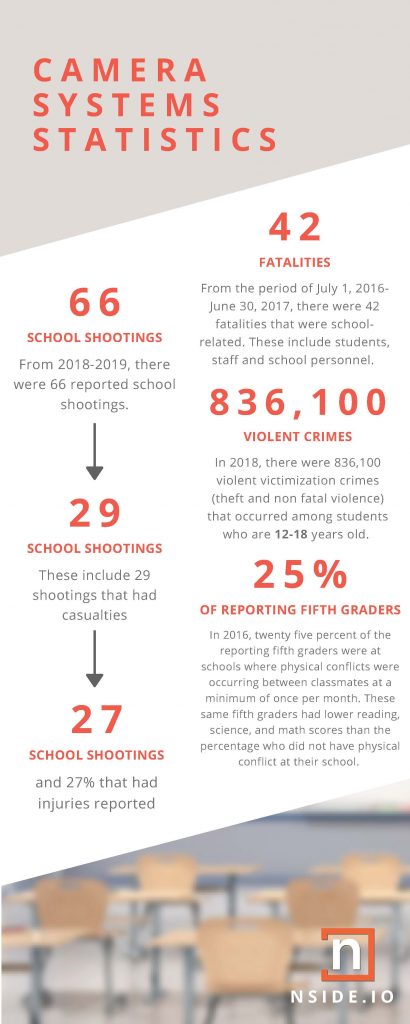
  • From the period of July 1, 2016-June 30, 2017, there were 42 fatalities that were school-related. These include students, staff and school personnel. 
  • In 2018, there were 836,100 violent victimization crimes (theft and non fatal violence) that occurred among students who are 12-18 years old. 
  • From 2018-2019, there were 66 reported school shootings. These include 29 shootings that had casualties, and 27 that had injuries reported. 
  • In 2016, twenty five percent of the reporting fifth graders were at schools where physical conflicts were occurring between classmates at a minimum of once per month. These same fifth graders had lower reading, science, and math scores than the percentage who did not have physical conflict at their school. 

Although these are certainly alarming trends, national data concludes that between 1992 and 2017, crime and violence are actually on a downward trend. This can be confusing, because the amount of school shootings is disproportionately higher, and can feel emotionally difficult for parents and educators. Of course, no level of violence in the school environment would be considered appropriate, but there are many factors which have led to a reduction in non-violent and violent crimes alike, and one of these is the addition of security personnel and cameras (Source). 

How Cameras Can Keep Schools Safer

 After 1999 (which was the year when the Columbine shooting occurred), the number of schools that reported using some type of security camera increased, rising from just 19% to 83% in 2018.  In August 2020, a joint effort from the Department of Justice and the Office of Community Oriented Policing suggested ten things that schools can do to improve their safety, and they listed campus and classroom security as third highest priority. The highest priority item was comprehensive school safety assessments, which we will discuss later. 

  1. Video camera monitoring can minimize students using or selling drugs on campus, and can deter theft. The National Institute on Drug Abuse (Source) suggests that installing cameras in locations such as parking lots can capture student interactions, or mitigate drug-related behaviors from high-risk students. As far as thefts, cameras have been shown to deter would-be burglars from things like locker thefts or parking lot thefts (student or staff vehicles). This applies to cameras that are installed with accompanying signs announcing their presence. 
  2. Video cameras in schools have also been shown to reduce bullying, which is a high concern for many parents and educators, and can lend itself to a feeling of instability for students. In some cases, installed cameras on school campuses reduced recorded instances of bullying up to 70%. The National Center for Education Statistics found that students were fearful of certain places on their campuses which did NOT have cameras or adequate camera surveillance, such as outside on school grounds. They also found that students avoided these areas out of fear of being targeted. 
  3. Video cameras can monitor and help identify shooters on a school campus. Surveillance cameras can be very useful to law enforcement when there are intruders or shooters, and capture vandalism and other non-violent offenses. It can also lower the liability for educators and schools, as their positive actions during a crisis are viewable.  

Why Schools May be Reluctant to Install Cameras

With any new advance in technology, there can be hindrances of many types, but the top three reasons that schools may be hesitant would be: concerns about student and teacher privacy, the cost of such a service, and making students or teachers feel suspicious about one another. We understand these are genuine concerns, and specifically want to address the issue of privacy. Our unique systems are made up of live monitoring systems that are only accessible to those who need to view it, such as law enforcement or other safety personnel. And in regards to cost, our technology  can use your existing cameras (if you have them) and integrates them into our system. If you do need new cameras, we can help guide you to the solution that suits your budget and needs. Lastly, the trust of students and staff has been shown to be highest in schools where the “school climate” is one of safety and security. This works hand in hand with your security plan and installation, fostering an overall environment of trust. 

How nSide | Live Works

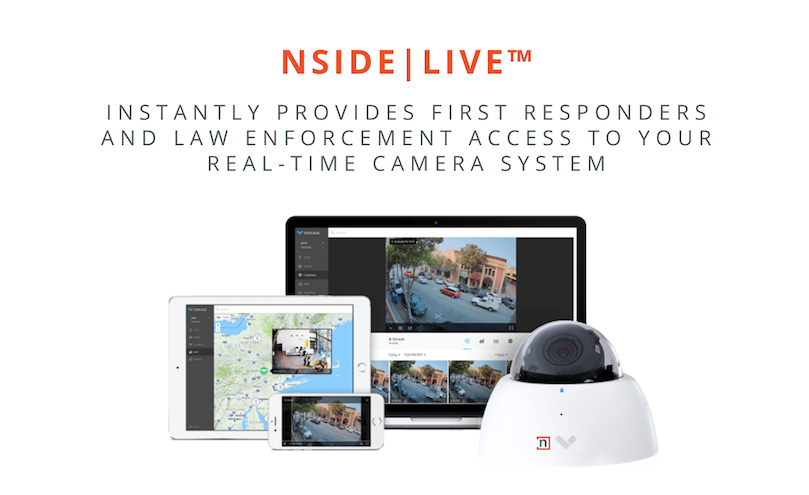
First, our qualified team will assess your current needs. This is relevant to the findings we mentioned above, which include making a comprehensive safety assessment and plan for your place of education. We will help you decide if you need new equipment, and make sure your current installations are working and in good order. Then, we will make sure your team is trained in using our systems, called nSide|Live. It’s live-time monitoring of your existing (or new, if you need them installed) cameras, and it can be viewed by high level administrators (school safety directors or principals with access) even from afar, and is safe and secure. You won’t need to worry about any unwanted visitors hacking into your secure systems and spying on teachers or students. 

In the event of an emergency, you will be able to grant access to first responders and emergency workers. This will get aid to your students, or help you intervene with an emergency situation, immediately. As an administration, you will be able to control who has access and when. Our system is different, because of the ability to grant and revoke access that is needed, based on the situation at hand. Many systems make it much more complicated, and leave their camera systems open to security gaps. No matter what your security camera needs are, we can assist you!

Safety Benefits Everyone

The findings from the most recent SSOCS report continued to affirm that the safer that students feel, the better they are able to focus and meet academic standards. Both students and the staff benefit from safety improvements such as installing cameras, and the long-term benefits of students who are successful in school stretch into the community. Without these safety standards implemented, students not only experience violence, they can also witness violence (which has lasting emotional and psychological effects). With a comprehensive safety plan, curating a secure and stable environment is possible and can help students and staff thrive in their roles. 

If your school is ready to take the next step, and assess the systems already in place, please let us know. We would love to sit down with you, address any security gaps, and help you move forward with a concrete plan to keep you, your students, and your staff members safer than ever. 

Sources: 

  • https://www.schoolsafety.gov/prevent/threat-assessment-and-reporting
  • https://www.cisa.gov/sites/default/files/publications/K12-School-Security-Guide-2nd-Edition-508.pdf
  • https://nces.ed.gov/fastfacts/display.asp?id=334
  • https://www.schoolsafety.gov/sites/default/files/2021-01/Ten%20Essential%20Actions_Quick%20Reference%20Guide.pdf 
  • https://www.drugabuse.gov/drug-topics/trends-statistics/monitoring-future/monitoring-future-study-trends-in-prevalence-various-drugs
admin
April 16, 2021
0
Share:

Flu Prevention Educational Materials

Protecting yourself and others from respiratory illnesses like the flu starts with you. The following are educational materials such as factsheets, videos and trainings on nonpharmaceutical interventions (NPIs) that you can print, watch, act on, and share with others.

Printable materials

Nonpharmaceutical Interventions and Community Interventions for Infection
  • Nonpharmaceutical Interventions and Community interventions for Infection Control Unit 
  • Cdc-pdf
Protect Your Children and Others from Flu Factsheet
  • Protect Your Children and Others from Flu Factsheet 
  • Cdc-pdf
Protect Your Students from Flu During the School Year
  • Protect your students from flu during the school year 
  • Cdc-pdf
Protect Yourself from Flu at a Public Event
  • Protect yourself from flu at a public event 
  • Cdc-pdf
Do Your Part to Slow the Spread of Flu
  • Do your part to slow the spread of flu 
  • Cdc-pdf

Training

The NPI 101: An Introduction to Nonpharmaceutical Interventions (NPIs) for Pandemic Influenza course is designed to assist state, tribal, local, and territorial public health professionals in preparing for and responding to pandemic flu in their communities through the use of NPIs. This interactive course educates learners on how to plan for the use of NPIs before, during, and after a flu pandemic to help slow the spread of flu

Register for “NPI 101”

SOURCE: “Educational Materials.” Centers for Disease Control and Prevention, Centers for Disease Control and Prevention, 2 Aug. 2017, www.cdc.gov/nonpharmaceutical-interventions/tools-resources/educational-materials.html.

admin
March 22, 2021
0
Share:

Why Fleet Safety Matters

Why Fleet Safety Matters

If you’ve ever been in a hurry, you know this feeling: getting trapped behind a big, yellow school bus, making multiple stops and driving slowly. We have all been there, frustrated with the slow speed, but there’s a reason why those buses have to be so very careful: they’re filled with precious cargo. Parents and guardians across the country entrust their children each day to the school bus systems, drivers, and routes. Although strides have been taken to make the school vehicles as safe as possible, there are still several areas of concern when it comes to this aspect of the education system, including traffic accidents, other drivers on the road, and strangers having access to the passengers or routes as they make their stops. So what’s an educator to do? How do you protect these precious passengers, and give your school staff and families confidence that the buses are as safe as possible? In this blog, we will explore how nSide’s innovative fleet systems work, and how they give everyone involved an extra layer of communication.

Who rides the school bus?

If you’re wondering who these routes actually serve, you may be surprised at the sheer numbers of students who use school transportation. Recent statistics from School Transportation News indicate that in the 2018-2019 school year, there were 1,365 crashes that involved school buses. This accounts for only a small fraction of the number of minors who rode a school bus during the same timeframe, which the American School Bus Council estimates at approximately 26 million students. In 2016, the statistics showed that approximately 20 million children who were younger than 9th grade rode the bus, and that the bus riders typically live more than two miles away from the school they’re attending. In addition to providing transportation for any child who may need it, it’s important to note that the bus provides opportunity for those who wouldn’t have access to a private, working vehicle. The same research showed that 20% of the children riding the bus in 2016 were from homes who’s income level fell below the poverty line. Even when low-income families own a personal vehicle, it doesn’t mean it’s easily accessible; obstacles like the cost of gas, a parent available to drive it, and a car that is good condition all can hinder the ability to get a child to school without help. On average, a school bus travels 12,000 miles per year, and replaces the travel of approximately 36 regular vehicles.

What has been done so far about safety on school buses?

Thankfully, these school vehicles are one of the most regulated transportation methods. Since their inception in 1914, when they were a very unreliable and dangerous carriage that provided almost no protection to its riders, the recognizable school bus has come quite a long way. One of the first changes made to provide a higher level of safety was innovated by Frank Cyr in the early 30’s, who was himself an educator, and it was to make all school buses the same color. In 1974, school fleets had all adopted the vibrant yellow color throughout the country, which made them more visible during early mornings and early evenings, when they were most heavily used. Since the mid 60’s, the safety features of the standard school bus have been regulated by the federal government, in order to comply with newer technologies and standards. 

The design of the actual vehicle is part of what makes modern buses more safe than a  regular passenger car. A child is actually seventy times more likely to get in an accident while riding as a passenger, than to get in an accident on the way to school on a bus. They feature things like flashing red lights, plenty of mirrors, and sturdy construction to best protect the children inside. Although the larger ones do not have required seatbelts, this is because they are constructed using a system called compartmentalization. Compartmentalization makes seats that can absorb energy in a crash, and help protect the riders in the event of an accident. The National Highway Traffic Safety Administration also monitors the minimum safety standards for a school bus, ensuring that there is accountability for bus manufacturers.

School Bus Accidents and Incidents

No one likes to look back and see instances where accidents or mishaps occurred involving school buses, passengers, or drivers, but they can help shape the safety standards for the future. There are several instances in the last ten years, where children were involved in these types of situations. 

In 2013, a five year old boy was taken hostage during a crisis in Midland City, Alabama. The perpetrator, Jimmy Lee Dykes, managed to board a school bus, where he shot and killed the driver and took Ethan Gillman (age five) hostage. Another student who was present on the bus called 911 when Dykes boarded the vehicle, and first responders were able to apprehend Dykes later on. He had proceeded to leave the bus with the child, barricaded himself in a self-made bunker, and was shot by the authorities. The little boy was thankfully rescued and lived through the harrowing event. During such an instance as this, nSide’s technology would allow bus drivers to receive emergency help more rapidly, and enhance their communication abilities. When time is of the essence (such as in a kidnapping), the goals are to prevent unauthorized access to the children, AND get help to the bus in a hurry, and nSide helps schools do both. 

Let’s take a look at a few more instances when things relating specifically to riding the bus went horribly wrong:

  • August 2018: Terry Bryant, age 11, was struck by a car in Florida and killed. He was waiting for a break in traffic to walk up the street.
  • September 2018, Destiny Chambers, age 8, was struck and killed by a vehicle, who committed a hit-and-run. She was crossing the street towards the bus, which was stopped.
  • October 2018: Jasmine Villareal, age 12, died as a result of her school bus rolling into a ditch and catching fire. 
  • March 2019: Rhindi Isaacs, deceased as a result of her school bus being struck by an SUV and catching fire.

These are grievous and horrible accidents that primarily involved drivers who failed to stop at the stop sign or for the flashing lights. Each year, the National School Bus Loading and Unloading Survey updates all the fatalities and accidents that occur during the entering and exiting at bus stops. Children who were under nine years of age account for the largest number of fatalities since the 70’s, and the current average shows that around 6 children die every year from bus-related accidents. Among the almost 1500 reported crashes researched by School Transportation News, approximately 16.5 percent were found to be the fault of the bus driver, school district, or private bus company. This is where many of the safety features of nSide’s amazing fleet communication system come into play.

How nSide’s Fleet System Works

We pride ourselves on combining the best of modern technology with accessibility for schools and their educators. One of our products is called nSide|Fleet, and it provides an extra layer of safety for school bus drivers, their passengers, and the staff that oversees them. As we mentioned above, with just over sixteen percent of accidents correlating to school or bus companies directly, it’s crucial that schools reduce their liability and make their modes of transportation as safe as possible. nSide|Fleet does just that; giving schools the ability to monitor their entire group of school buses in just a few clicks of a mouse. Not only can they access this digitally, it can be securely accessed no matter where you are. For administrators and principals, this means you can check in on any situation while on the go. Here are some of the benefits of the service:

  • View accurate reports on speeding vehicles, so you can monitor the safe driving habits of the drivers you hire.
  • Geofencing is a way to use location in tandem with information. With geofencing, you can view when a driver leaves a route, and determine a possible reason for doing so. Helps keep driver’s accountable to the routes they should be following. This feature also helps keep the routes running on time and on track, and sets up the ability to send notifications for when the bus enters a given area.
  • Maintenance Monitoring: View maintenance codes and fuel levels on all vehicles. This feature enhances safety by preventing problems before they occur (with fuel levels), and preventing problems with lack of vehicles or sudden shortages due to required maintenance.
  • View time logs: Perfect for transportation managers, viewing time logs helps you with staffing numbers and budgetary concerns by seeing which drivers are efficiently managing their routes.

How Bus Safety Benefits Everyone

Obviously, the primary beneficiaries of increased bus safety are the students who use it as a mode of transportation. But on top of this most important benefit, parents will benefit as well. They will have peace of mind knowing that the school has eyes on the buses it utilizes, and knows where their children are at all times going to and from the school. Lastly, one of the primary benefits of using such a system is that the school has backup: by using nSide, they have a system set in place that gives drivers accountability and confidence while they are on the road. With nSide, your school bus fleet will be safer on the road and off. This means that on the roads of your community and city, both pedestrians, students, and other drivers will benefit from the added monitoring. 

Are you ready to get started with a customized quote? We would love to help you get your bus fleet set up with these unique safety features, and help keep all of your students safe on that morning and afternoon commute.

Sources

  • https://www.bts.gov/topics/passenger-travel/back-school-2019
  • http://www.americanschoolbuscouncil.org/insights/safety/
  • https://www.nhtsa.gov/road-safety/school-bus-safety
  • https://www.atu.org/work/school (Canada specific)
  • https://www.nysbca.com/fastfacts.html
  • https://www.smithsonianmag.com/history/history-how-school-buses-became-yellow-180973041/
  • https://www.stanfordchildrens.org/en/topic/default?id=how-safe-is-the-school-bus-1-1133

Written by Grace Aspinwall | Silverbeet Creative Co.

admin
March 22, 2021
0
Share:

Preparedness is Key in Emergency Situations

Preparedness is Key in Emergency Situations

When it comes to an emergency situation, it’s often said that “preparedness is key”. When the emergency is a school shooting or a shooter on a campus, being prepared can be the difference between life and death for students, teachers, and staff members. The unthinkable nightmare of a gunman on campus is something no child or educator should have to consider, but that’s exactly what unfolded on November 14th, 2019 in Santa Clarita, California. A student at Saugus High School opened fire on his classmates, killing two, and then turning the gun on himself. Gracie Anne Muehlberger, age 15, and Dominic Blackwell, age 14, both lost their lives in this tragic event. 

On the day of the shooting, most teachers and students began their day just like any other, getting classrooms set up and arranged, and getting lessons underway. In an interview with CNN, teacher Kaitlin Holt explains how she was playing back a recent choir performance for her students so that they could analyze it. They had no idea that their day was about to be turned upside-down, as news of a shooter began to trickle into their classroom. Because they had not heard the gunshots ring out in their particular part of the building, they were unaware of the situation as it was happening. A young lady who had been shot came into the classroom, in shock, and not realizing she had two gunshot wounds. Kaitlin risked her own life to exit the classroom and find the supplies in a gunshot wound kit that would help her treat the wound. Her quick thinking about where the kit was located, and how to stop a bleed was incredibly important. “We had watched a tutorial on how to use that in one of our staff meetings and I did that the best I could,” she told CNN. 

Her students cooperated beautifully during such a stressful time, and Holt further explained that they had been through lockdown training at the school, to prepare for what they hoped to never experience. This training proved invaluable as the students knew to lock the doors, help create barricades, and to stay quiet and hidden. Holt ushered them into her office, which had locking doors, and worked to create an atmosphere of calm and confidence. Additionally, she shared with the news station that she felt the immense gravity of the situation, and didn’t feel that being a paramedic should be part of a teacher’s job, since there are such life and death consequences, adding, “That should not be part of the teacher’s job”.

How does nSide help?

Kaitlin Holt, the choir-teacher-turned-paramedic, repeatedly emphasized that she barely had time to think through her options in a situation that she had never anticipated before, but it draws attention to her excellent training. She knew what to do, where to go, and how to best assist her students, even without all of the information or the location of the shooter. She knew where medical supplies were located and how to use it, and where the safest location was. She also knew how to close off exits in the room, and where each one was. Training like this is crucial when it comes to protecting students, and it’s one of the reasons that nSide exists. Although our hope is that no teacher or staff member would ever have to use their emergency training, we desire to equip faculty members with confidence and training that will kick in, no matter the adrenaline, shock, or unknowns that are occurring around them. It’s easy to think through these things before they happen, but when they ARE happening, have you practiced enough for it to be second nature? Have you put enough precautions in place before the emergency? We want every student, teacher, or staff member to be able to answer this with a resounding YES. 

Since 2015, we have been thinking through what it means to truly feel secure in the walls of a school. Unfortunately, there are many things in our modern times that pose threats to staff and students in the academic setting. History has shown that emergencies can happen at any time, in many forms. Although this is sobering, there are things that can be done before the emergency that will set educators up for success, instead of chaos. Here at nSide, we are broaching the topic of school safety head-on. After all, when it comes to our children, straightforward answers and education are powerful tools, and school safety should never be passive.

Preparation can save lives

In the instance of this brave, amazing teacher, we saw how her preparedness and training worked together to allow her to make split-second decisions in a horrible situation. The things that were done ahead of time truly mattered. Saugus had practiced lockdowns with their students, so the students knew that panic and noise would increase their level of danger, and they cooperated to assist their teacher. Their bravery was based out of one of our key concepts: training works. Here are some of the ways that nSide can give schools peace of mind by equipping them with the training they need and want: 

  • Emergency Operation Plans: These plans are built on a cloud system, and allow accessibility school-wide, in the event of an emergency. Rather than being caught off-guard, teachers like Kaitlin Holt would know immediately if there was a threat to their classroom, and would have time to assess the situation. While Miss Holt had access to some of these types of features, such as location of exits, and locations of medical items, having an earlier notification would have given her additional breadth. Our systems use a combination of surveillance, communication, and controlled access so that those who need to know, do. No parent loves the idea of strangers having access to viewing the school, so the access is private and controlled, enabling parents, staff, and educators to be in rapid communication with each other when necessary. 
  • Training Sessions: Our training modules are research based and include subjects such as “Active Shooter Training”. We work with other organizations and partners to provide the most up-to-date and current training. We also work off the WICC Model of training, which stands for “Warn, Information, Choices, Communication”. It focuses on how to warn the school of an incident or impending situation, notifying and providing crucial information to those who need to know (public, media, parents, staff), equipping everyone to make appropriate choices, and communicating effectively. In her CNN interview, that brave choir teacher noted that her students had done lockdown drills before, and that’s why they knew precisely how to behave. These drills, when done appropriately, can decrease chaos and fear in the moment. 
  •  Mapping and Location: One of the biggest and most crucial moments in the Saugus High School shooting was when Miss Holt made the decision to secure her students and exit the classroom to find the gunshot wound kit for her student. She knew very quickly where it was, and how to find it. This was lifesaving for the student who had two gunshot wounds, and saved valuable time while things were still very unknown. Our mapping and location plans give staff the ability to troubleshoot on the fly by knowing where exits are, where the access points are, where medical items (such as AED machines or gunshot wound kits) are located. This step can give back the gift of time to those who are protecting children on campus. That time can mean the difference between life and death for people with deadly wounds, so why not buy back every precious moment by fully mapping your locations?

Why this matters

Although we have talked about preparing our educators and students, we sincerely believe that just as a choir teacher shouldn’t be asked to be a first responder, a school shouldn’t have to do these safety measures alone. With the rise of mental health crisis’ and school emergencies, teachers and staff have many critical items already on their very-full plates. So, that preparation should be taken care of, long before the school day begins. That’s why nSide can do the planning and preparing for you, with our comprehensive safety plans and evaluations. Our experienced and trained team can discuss the best routes of action for your facility, based on the size of the school, the ages of the students, and the location. We can give your teachers back their peace of mind by making their response second-nature, and removing doubts from their actions. Not only will our secure, inclusive plans set your school apart when it comes to safety, it will also speak volumes to concerned parents, who entrust their children to your school each and every day. Teachers are not first responders. It’s not in the job description. Let your teachers be teachers, and let us tackle the issue of school emergencies. 

If you’re interested in learning more about our series of products and services, please reach out to us at help@nside.io. We would love to share more about how we can help shape a culture of safety at your organization.

Written by Grace Aspinwall | Silverbeet Creative Co.

admin
February 25, 2021
0
Share:
1 … 8 9 10 … 12
nSide™

Copyrights © 2015 - 2022 nSide™ | All rights reserved.